

View The Bells On Display!

History of The Bells
1. Saint Brigid's Bell
Location: 1st St & 3rd Ave


To meet the needs of a growing population of Catholics in the Port Schuyler area, a church on the northwest corner of Salem (4th Avenue) and Mansion (7th Street) was dedicated on July 11, 1851. A Troy Clinton Meneely bell was installed in 1883. Clinton, the youngest son of Andrew Meneely had worked as a clerk in the West Troy Foundry gaining knowledge of bell casting before joining the Union Army during the Civil War. Upon his return family disputes led to his establishment of the Troy Meneely Foundry. Hard feelings between the two firms lasted for over fifty years. The West Troy and Troy Meneely Foundries became two of the seven major bronze bell foundries in the United States. The firms traced their lineage back to Paul Revere who operated the first American bell foundry. Andrew Meneely learned bell founding through Julius Hanks and his father Benjamin Hanks who tutored at the Revere foundry. Originally the West Troy Foundry made bells, bronze cannons, engineering equipment and tower clocks. Some of these important bells include: • a replacement for the original Liberty Bell (cast in 1876 for the Centennial) that hangs today in the bell tower of Independence Hall, Philadelphia. This is not a replica of the original bell. Rather, it is a much larger bell, weighing 13,000 pounds, a thousand pounds for each of the original thirteen states. • four bells on the Metropolitan Life Insurance Tower in New York City. According to Sydney Ross in his Gateway booklet entitled The Bell Casters of Troy: “These bells are 700 feet in the air, and are by far the highest hung bells in the world. Their sound has been reported by voyagers at sea, beyond Sandy Hook, New Jersey, fully twenty-eight miles from the tower, and by others on Hudson River boasts, equally as far to the north.” To this day, there are Meneely bells on every continent on the planet except Antarctica. This bell was removed from the steeple of St. Brigid’s Church on October 4, 2023. This bell was donated to the City by the owners of Wicked Smart, Todd and Marcie Van Epps, and it’s removal from the church steeple was paid for by the Watervliet Charitable Foundation.
2. Richard & Patricia Crinigan Memorial Bell
Location: Gazebo Park 6th St & 3rd Ave
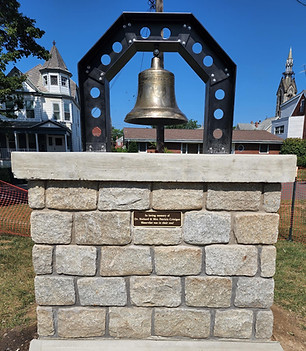

Pat and Dick lived in Watervliet for 69 years and served as active parishioners of St. Brigid’s Church the entire time. Pat taught at St. Brigid’s for 48 years and so loved the youth of Watervliet. Their favorite charity was Arsenal City Kids and to the end, they believed Watervliet was Heaven on Earth. Thank you to the Watervliet Historical Society, located at the Dutch Reformed Church at 1501 1st Avenue. Residents and visitors are encouraged to visit the museum to learn more about the great role Watervliet played in the industrial revolution. Special thanks to Mayor Charles Patricelli for his role in making this memorial a reality; to Tom and Marylou Ragosta for providing the historical information; to Scott Boisvert, Jim Delgiacco, Mark Aragona and Bonded Concrete for the construction of this memorial; and to Peg Germano for purchasing the bell in memory of her late husband, Joe.
3. Eugene Burns Memorial Bell
Location: Museum 1501 1st Ave


Gene Burns is our Meneely Bell, West Troy expert. He has had a passion and has researched Meneely Bells for over 70 years. This·bell was purchased by his family for Gene a number of years ago as a Christmas present. This 17 inch diameter based and l00lb bell tolled in a school house in Cobleskill N.Y. It was displayed in the Burns Living room for many years until he loaned it to the Watervliet Historical Society so that all can enjoy.
4. Meneely Eleven Bell Chimola
Location: Museum 1501 1st Ave

This eleven-Bell set was cast for the Trinity Evangelical Church in Bangor, Pennsylvania on March 18,1926. The origin of the term Chimola is uncertain. It appears to have been used by the Meneely Bell Foundry in conjunction with chimes made of hemispherical bells. Chimola's consists of 4-20 hemispherical bells. Five were made by the Meneely Foundry after West Troy became Watervliet. Hemispherical Bells seem to have been produced and sold as a relatively inexpensive alternate to conventional tower bells. Also they were lighter in weight and thus could be fitted into towers for which conventional bell might not be suitable. They produce a pleasant bell-like sound but were never a great success.
5. North Dutch Reformed Church Bell
Location: Museum 1501 1st Ave
This 50" diameter based and 2500 lb. bell was the third bell which tolled for its congregation, the first was cracked on March 18,1854 when the steeple of the church fell to the ground destroying the clock and bell during a raging storm. The second bell was destroyed on April 18,1900 when fire broke out in the steeple. Ironically the fire was caused by faulty electric wiring which had been installed to operate the ringing of the church bell as a fire alarm for the city. You will note that the inscription on the bell documents the tragedy of the fire. This bell was dedicated to Eugene Burns, Watervliet’s Meneely Bell Expert. He had a passion for and researched Meneely Bells for over 70 years, culminating with the publishing of the "Meneely Bells of West Troy" prior to his passing.
6. Baptist Church Bell
Location: Watervliet Library lobby 1501 Broadway


This 36" diameter base and 1300 lb Bell tolled in the Baptist Church in Eaton,NY. It was donated to the City of Watervliet by the former Covert Manufacturing Company in Watervliet, NY. The purchase price in 1832 when cast was $390.00 and the cost when purchased by Covert was $10,400.00. This is the oldest Bell in the Watervliet collection cast 6 years after the foundry opened in 1826.
7. St. Veronica's Church Bell
Location: Watervliet Senior center 1501 Broadway


This 1904 West Troy Bell tolled in St. Veronica’s Catholic Church until the early 1990’s when declining attendance forced closure. The building was torn down and the bell purchased by a parishioner who made it available to the City of Watervliet. Many bells were inscribed with Latin verses, as seen on this bell. The rough translation: “Maria Veronica, 1904, dedicated to the glory of God, celebrate the sound of Christ, Christ is everything”. St. Veronica is associated with the image of Christ’s face on her veil when wiping it as he carried the cross to Calvary. To memorialize the history of this famous foundry here in Watervliet, the bell was purchased by the Watervliet Charitable Foundation. From 1808 until 1951, four foundries in and across the river from Troy cast and shipped bells to destinations all over the world. The following excerpt from Hudson Mohawk Gateway: An Illustrated History by Thomas Phelan describes the region’s bell industry: “The greatest name in Gateway bells was undoubtedly that of Andrew Meneely. At seventeen he was apprenticed to Julius Hanks and even married one of Hanks’ nieces. In 1826 he founded his own firm in Gibbonsville (Watervliet). Meneely is credited with the invention of the ‘conical rotary yoke,’ later catalogued as ‘the most desirable and perfect rotary yoke in the world.’ His firm remained a family-held, single-product business for well over a century, casting some of the most important bells, pads, and chains used in this country and abroad.” Some of these important bells include: • a replacement for the original Liberty Bell (cast in 1876 for the Centennial) that hangs today in the bell tower of Independence Hall, Philadelphia. This is not a replica of the original bell. Rather, it is a much larger bell, weighing 13,000 pounds, a thousand pounds for each of the original thirteen states. • four bells on the Metropolitan Life Insurance Tower in New York City. According to Sydney Ross in his Gateway booklet entitled The Bell Casters of Troy: “These bells are 700 feet in the air, and are by far the highest hung bells in the world. Their sound has been reported by voyagers at sea, beyond Sandy Hook, New Jersey, fully twenty-eight miles from the tower, and by others on Hudson River boasts, equally as far to the north.” To this day, there are Meneely bells on every continent on the planet except Antarctica. More than 65,000 bells were cast under the Meneely brand between 1826 and 1951, when the business closed. Upon the death of Andrew in 1851, his sons took over the business and the family continued to cast Meneely bells for another 100 years.
8. St. Patrick's Church Bell
Location: 19th St & 2nd Ave South side of bridge


The most obvious music associated with any church is the sweet and dignified tolling of the church bell. Pictured above is George E. Hipwod, President of the Holy Names Society who presented the bell for placement in the new church. The bell was manufactured by the Meneely Bell Foundry of Watervliet for the former Saint Patrick’s Church in 1906. They were the master bell maker at that time. Perched in the tower at an altitude of 125 feet, the bell could be heard throughout the city. Its sweet toned sound is in the key of Bb international pitch I.e., the bass clef. The instrument weighing 11,000 pounds mounted is made of the purest metal, 78% copper and 22% tin. The bell, a gift from the Holy Names Society cost $3500. It was made and delivered within 60 days of the receipt of order. In 1890 the former St. Patrick’s church located on the southwest corner of 23 rd Street and 4 th Avenue became totally inadequate for the number of parishioners. As a result, a new church was built on the north side of Nineteenth Street between 5 th and 6 th Avenue, a facsimile of the church at Lourdes, France. Heartfelt gratitude to the Nigro Companies and the Immaculate Heart of Mary Parish for donating the Saint Patrick’s Bell to the Watervliet Historical Society. A special thanks also to Streck’s Inc., Bonded Concrete, the City of Watervliet, Tom Allison and the Watervliet Charitable Foundation for their assistance in making this display possible.
9. Meneely Pennsylvania Bell in appreciation to Tom & Marylou Ragosta
Location: 23rd St & 2nd Ave on boulevard in middle of street


This bell was removed from a Pennsylvania Church during remodeling. Unfortunately, the name and location of the church wasn't known. The bell has a 21" diameter at the base and weighs 200 lb. No date is embossed on the bell but the inscription Meneely and Co., West Troy, N.Y." dates the bell as being cast after 1874.
10. United Methodist Church bell
Location: Lower Hudson at the entrance of Hudson Shores Park


In 1831the Methodist Episcopal Church of Gibbonsville was erected on the South West corner of Washington and Ferry Street (Pt Avenue and 14th Street). It wasn't until1883 after a fire to the original structure and erection of the present brick structure that a Troy Clinton Meneely Bell was placed in the steeple. The diameter of the bell base is 53 inches, weighing 3000 lbs. The inscription embossed on the bell is "Washington Street Methodist Church, West Troy, New York AD 1883-Let Him that Heareth Say Come". Also embossed on the back of the bell "Clinton Meneely Bell Company, Troy, New York U.S.A. AD 1883." Clinton was the youngest son of Andrew Meneely and served in the Civil War as a Colonel. Upon his return and not owning a share in his older brother's business in West Troy he established a bell foundry in Troy, New York in 1869. The Troy firm quickly became competition for the West Troy namesake.
11. Meneely Foundry
Location: 1531 - 1541 Broadway, just north of the Senior Center no longer there


The Meneely Bell Foundry was established in 1826 by Andrew Meneely, a former apprentice in the foundry of Julius Hanks. Meneely was one of the greatest bell makers in American History. More than 65,000 bells under the Meneely brand were cast between 1826-1951when the business closed. The brick building occupied a front of 120 feet on Broad Street (Broadway) and extended 200 feet to Rochester Street (1st Avenue) where there was a 150 feet frontage. It included a yard for storage of coal, etc. The original factory produced clocks, engineering instruments as well as bells. By 1836 the foundry became one of the largest and most acclaimed bell foundries in the country. Soon its reputation spread internationally. Meneely manufactured a variety of church, academy, factory, depot, fire alarm, steamboat, ship, locomotive, plantation, fire engine, light house and other bells including chimola and carillons. Foreign competition with cheaper labor costs, cast iron bells and unavailability of metals due to World War II were all factors in the closing of the foundry in 1951.
12. Andrew Meneely Mansion
Location: 125 1st Ave No longer there, approx behind the McDonalds

The first listing of the Meneely home was in 1854 when the Troy Directory was published and included the village of West Troy (former name of Watervliet). At that time First Avenue north of 15th Street was called Rochester Street. The listing read Rochester between Canal (16th St) and Buffalo (15th). Street and avenues names were introduced with the present house numbering system in 1888. When the new system took place, the address of the Meneely Mansion was 1525-1st avenue. Many gala functions were held at his residence during the nineteenth-and first half of the twentieth century including three generations of Meneely's. A fire at the abandoned home in1974 and demolition for urban development (senior housing and senior center) spelled the end of the Meneely Era.
History of the Meneely Bells 1826


